
From Data to Decisions: What It Really Means to Digitalise Hotel Management
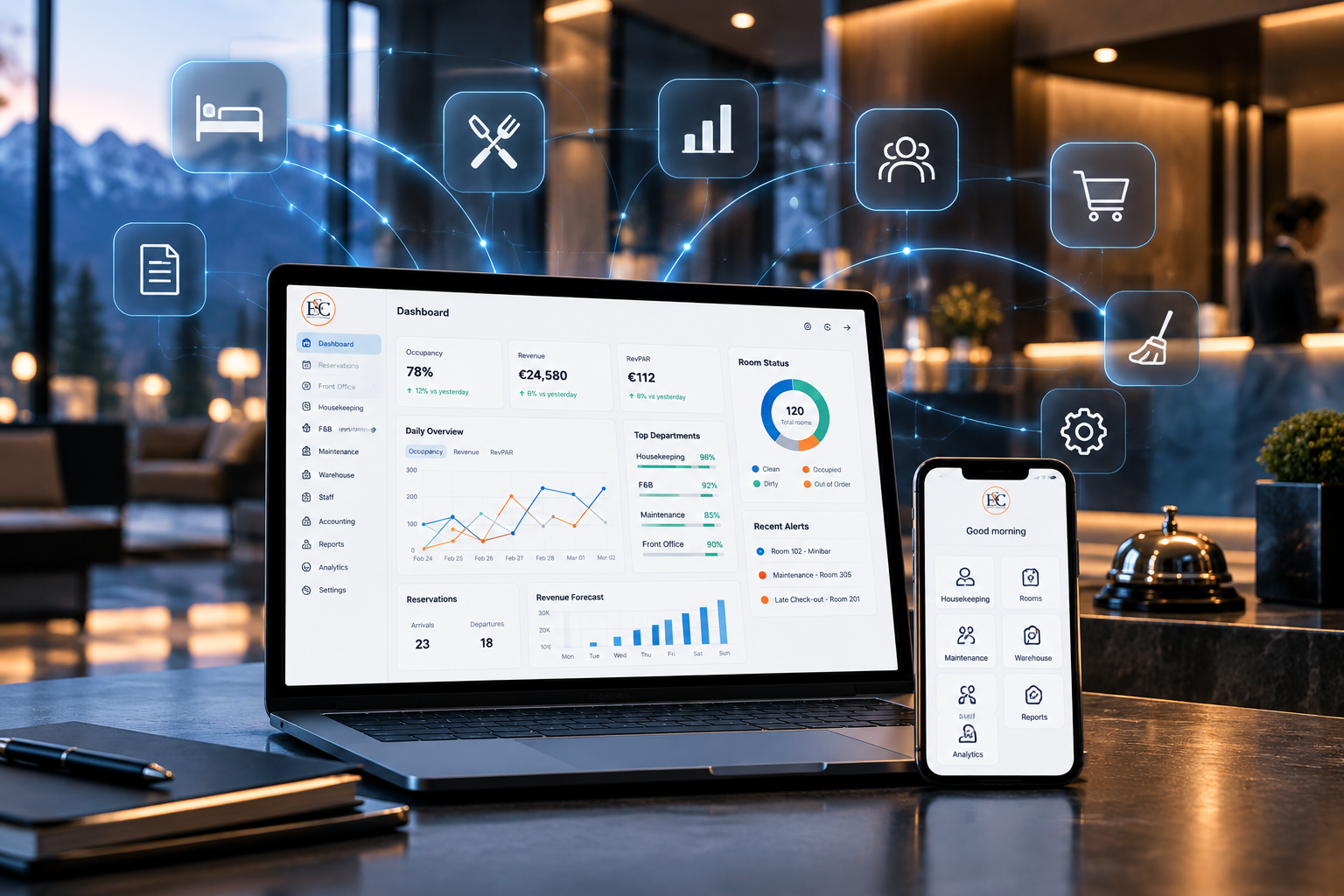
How much information does a hotel generate in a single day?
Bookings and cancellations. Occupied rooms. Restaurant consumption. Staff shifts. Inventory. Guest requests. Costs. Events.
The problem is often not a lack of data.
It is being able to connect it and transform it into useful information for making decisions.
This is one of the topics explored in the cover story that Albergo Magazine dedicated to digitalisation in the hospitality industry through an interview with Jan Vlasák, Director of the Bonfanti Design Hotel and Owner & CEO of Easy System Control.
From separate information to a complete view of the hotel
A hotel is made up of different departments, but it operates as a single system.
A change in occupancy can affect housekeeping workloads, the quantities required in the kitchen, staff organisation and the use of supplies.
When this information remains scattered across different tools, understanding the relationships between these areas becomes more difficult.
In the interview, Vlasák explains that this fragmentation was one of the needs that led to the development of ESC: creating a system capable of collecting information from different areas of the hotel and making it possible to view and interpret it together.
But collecting data is only the first step.
Knowing what happened or preparing for what comes next?
One of the most interesting aspects explored by Albergo Magazine is the combined use of current and historical data.
Knowing today’s occupancy is useful.
Comparing it with bookings, cancellations and trends from previous periods, however, makes it possible to start thinking about what may happen in the days ahead.
The same applies to other areas.
Historical consumption data can help plan Food & Beverage requirements. Staff data can be analysed in relation to occupancy and events. Information about supplies can support more accurate inventory management.
From this perspective, digitalisation is not only about recording what happens.
It can help a hotel prepare more effectively for what needs to happen next.
Data becomes useful when it changes a decision
Having a dashboard full of numbers does not necessarily mean understanding your hotel better.
The important question is different: which decisions can we make better thanks to that information?
How many staff members will be needed?
How much do we need to purchase?
Which consumption patterns are changing?
Where are results deviating from what we expected?
Which resources will need to be available in the coming days?
This is the point at which data stops being simply something to record and becomes a management tool.
The interview illustrates this approach through several practical applications of ESC, from occupancy and consumption to resource management and seasonality.
The right question comes before the technology
There is, however, one aspect that applies beyond ESC itself.
Not all the information available in a hotel is necessarily useful, and not every hotel needs to monitor the same things.
For one hotel, the priority may be to better understand consumption. For another, it may be staff organisation. For another still, it may be identifying inefficiencies in internal processes.
This is why ESC Agency starts by analysing the hotel and its critical areas, before selecting the tools to use.
Technology can collect, connect and process an enormous amount of information.
But first, we need to know which questions we want to ask of that data.
Albergo Magazine explores these topics in its interview with Jan Vlasák on the digitalisation of hotel management and the development of ESC.