
ESC: From a Real Hotel Need to a Management Tool
How did ESC come about?
Not from a technology project designed at a desk, but from a question that emerged from the day-to-day management of a hotel: how can we gain a clearer view of what is happening across different departments and use this information to work more effectively?
The story of ESC – Easy System Control has been featured by L’Agenzia di Viaggi Magazine and GuidaViaggi, which explored the project, its origins and the opportunities offered by digitalisation in the hospitality industry.
First of all: what is ESC?
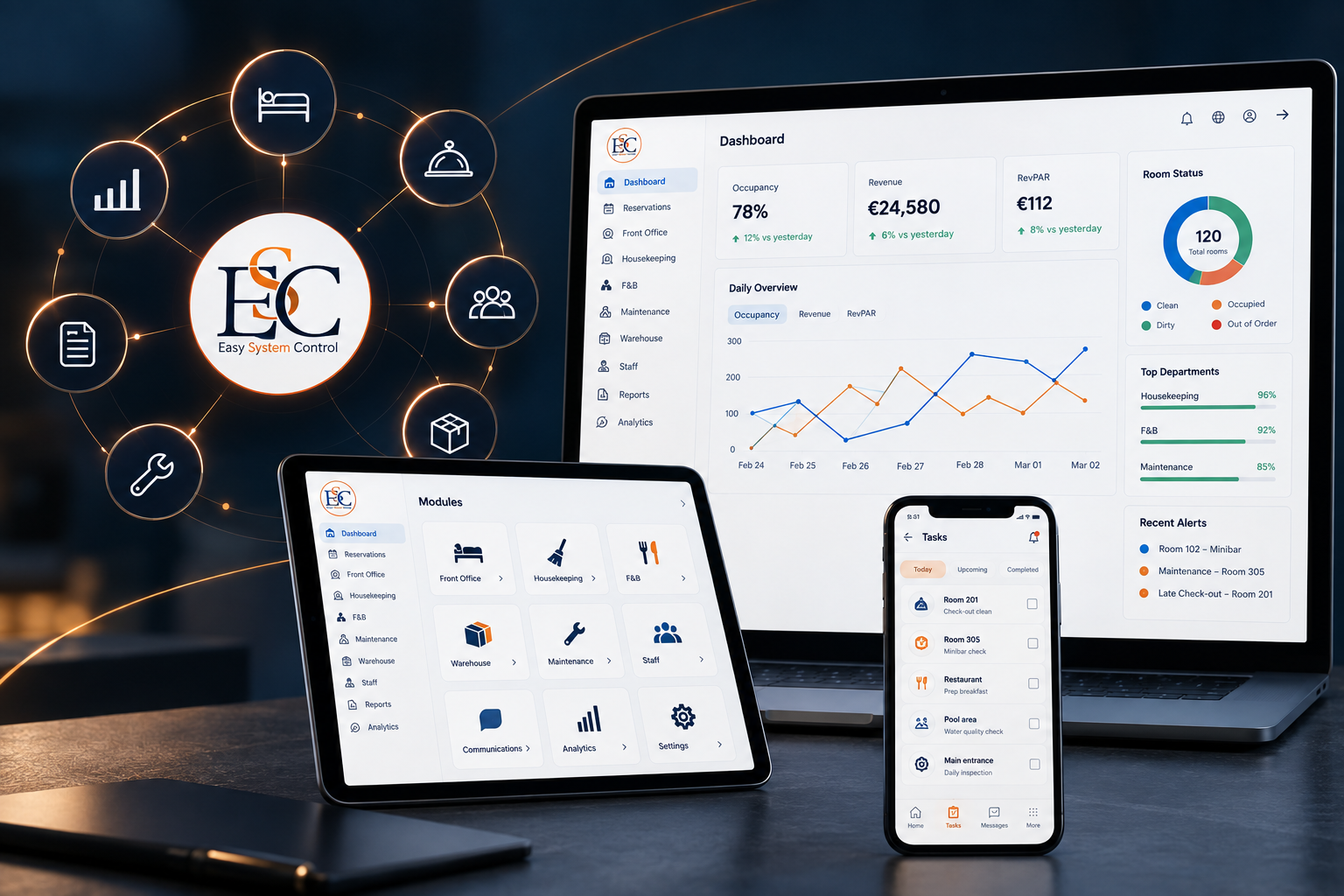
ESC is a digital platform developed to support hotel operations.
Its aim is to connect information and activities from different areas of the property, making it possible to monitor processes and use operational data to support decision-making.
Its approach is modular: not all hotels have the same services, size or needs. For this reason, its features can be used according to the specific requirements of each hotel.
But to truly understand ESC, we need to start with what happened before the software existed.
It all starts inside a hotel
The idea originated from the experience of the Bonfanti Design Hotel in South Tyrol.
Managing a hotel on a daily basis means coordinating reception, housekeeping, food and beverage, inventory, maintenance, staff and many other activities. Each department generates information and makes decisions, often using different tools.
By observing this reality, the need emerged to better connect what was happening across the different areas and make processes easier to understand.
ESC was therefore developed starting from the hotel’s real operations and refined over time through direct experience with real-world situations.
This origin also explains why the project does not focus exclusively on data collection. Data becomes useful when it helps someone decide what to do.
An example: how much breakfast should we prepare tomorrow?
The buffet provides a very practical example of this concept.
Preparing too much means creating surpluses and waste. Preparing too little can negatively affect the guest experience.
The solution developed through ESC uses information naturally generated by the hotel, such as guest numbers, guest nationalities and historical consumption data, to help forecast the quantities required.
In the case of the Bonfanti Design Hotel, L’Agenzia di Viaggi Magazine reported a 28% saving on raw materials in buffet management.
The value of this result lies not only in reducing costs, but also in how it was achieved: by gaining a better understanding of the hotel’s own operations in order to plan more accurately.
From software to consulting
The experience gained during the development of ESC highlighted something that is now also central to ESC Agency: two hotels may appear to have the same problem while actually requiring completely different solutions.
Before choosing a tool, it is therefore essential to understand what is happening within the hotel, where inefficiencies arise and which information is truly needed.
ESC can be one of the available solutions, but choosing the tool comes later: first, it is necessary to understand how the hotel actually operates.
The starting point is the hotel.
L’Agenzia di Viaggi Magazine and GuidaViaggi have covered the ESC project. You can read the original articles here:
Read the article on L’Agenzia di Viaggi Magazine
Read the article on GuidaViaggi
Would you like to discover what optimisation opportunities exist within your hotel?
Contact us for an initial consultation: we start with your processes, not with the software.