
Hotel Maintenance: Why Acting Early Costs Less Than Dealing with Breakdowns
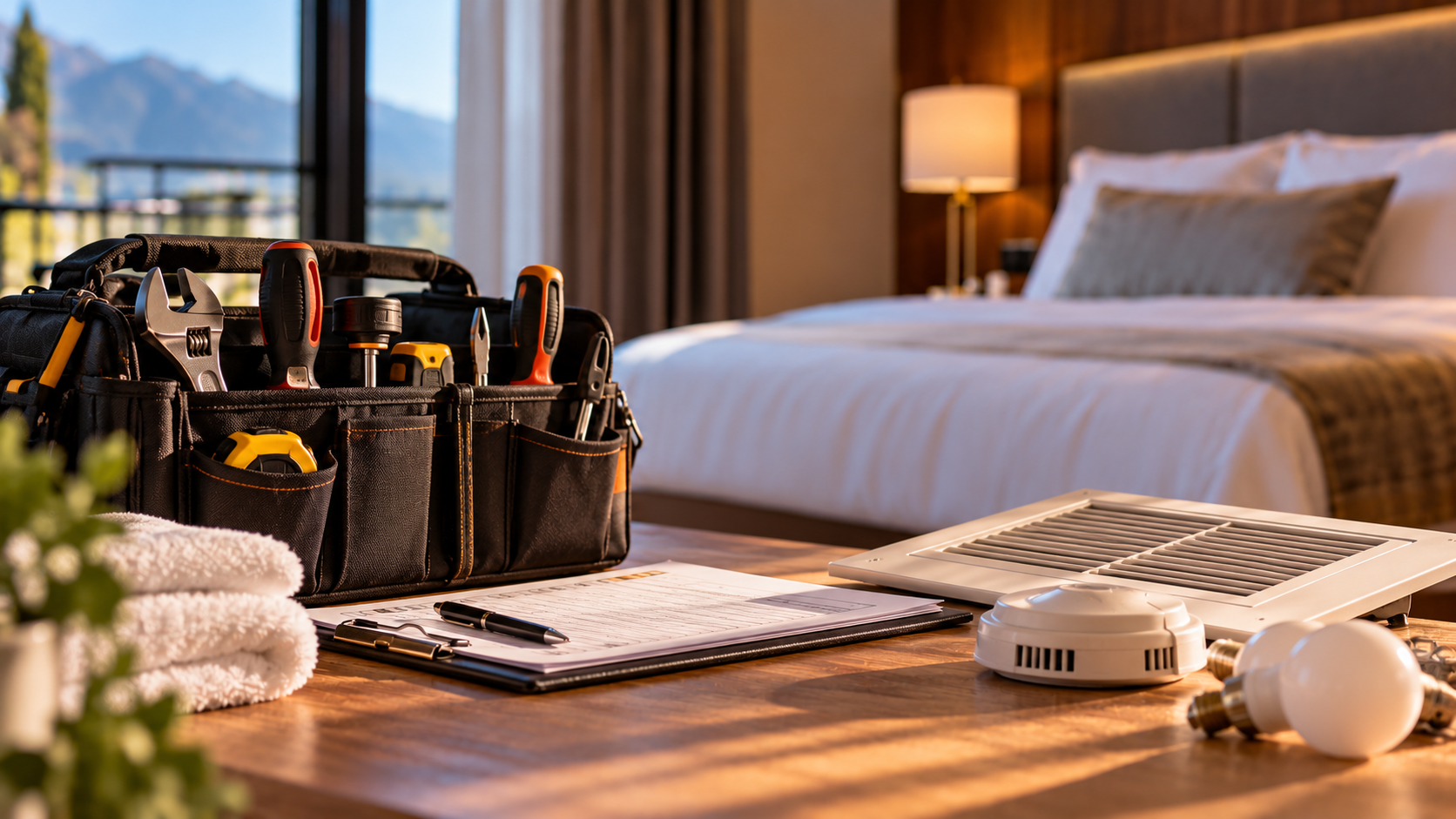
A room out of service because of an air conditioning failure. An elevator temporarily unavailable. A water leak requiring urgent repairs during a weekend of high occupancy.
In a hotel, a technical problem rarely remains limited to the system or equipment where it originated. It can involve staff, interrupt a service, require guests to be relocated and, in more complex cases, affect room availability.
Yet maintenance is often given attention primarily when something stops working.
How much could a hotel save if it managed to prevent at least some of these unexpected problems?
The cost of a breakdown goes beyond the repair
When a technical problem occurs, the first obvious expense is the repair itself: labour, spare parts and any external technical assistance.
But its financial impact can be much greater.
Imagine a breakdown that makes a room unavailable for two nights during a period of high demand. If the hotel has no alternative accommodation available, it may need to relocate the guest to another property, incur additional costs or lose a potential sale.
Meanwhile, reception must manage the situation, the maintenance team must reorganise its priorities, and other departments may need to become involved in resolving the problem.
Even when the breakdown is repaired quickly, its consequences can therefore extend far beyond the cost of the replaced component.
To properly assess the impact of maintenance, it is useful to consider the total cost of the service disruption, including potential revenue losses, resources used and effects on the guest experience.
Corrective, preventive and predictive maintenance: three different approaches
Not all maintenance activities follow the same approach.
Corrective maintenance is performed when a component fails or malfunctions. It is unavoidable in certain circumstances, but an organisation that relies mainly on emergency interventions risks making costs and response times unpredictable.
Preventive maintenance, on the other hand, involves scheduled inspections and interventions based on elapsed time, equipment usage or manufacturers’ technical recommendations.
Regular filter cleaning, air conditioning system inspections, kitchen equipment checks and plumbing inspections are examples of activities that can help reduce the risk of unexpected failures.
Predictive maintenance uses data on equipment condition and performance to identify signs of deterioration and estimate when intervention may be necessary.
This last approach requires specific tools and information and is not necessarily suitable for every hotel or system.
The choice depends on how critical the equipment is, the cost of maintenance activities and the consequences of a potential shutdown.
When a minor issue becomes a major problem
Not all breakdowns happen suddenly.
A leaking tap, a door that is difficult to close, an air conditioning unit making unusual noises or a temperature that does not remain stable may be early signs of a problem.
These issues are often noticed by employees who use the facilities every day: housekeeping, reception, restaurant or kitchen staff.
The critical point is what happens after the issue is reported.
If information is communicated only verbally, it may be forgotten during a shift change. If it is sent to several people without a clearly assigned person responsible, it may be unclear who should take action. Without a record, it becomes difficult to verify whether the problem has already been resolved or has occurred before.
Effective issue reporting should make it possible to identify the nature of the problem, its priority, the person responsible for addressing it and its current status.
Timely maintenance also depends on the quality of the information received by the maintenance department.
Not all maintenance requests have the same priority
Maintenance requests in a hotel can be numerous, especially during busy periods.
A light bulb that needs replacing in a service area, an air conditioning failure in an occupied room and a malfunction affecting a safety device require different responses.
Setting priorities means assessing risks to people, the impact on service, the urgency of the intervention and the financial consequences of a possible delay.
Safety-related issues must, of course, be managed in accordance with applicable regulations and procedures.
For other interventions, a shared classification system can help the maintenance department organise its work and reduce constant interruptions caused by requests that are all treated as equally urgent.
Scheduling also matters. Whenever possible, interventions requiring access to guest rooms can be coordinated with housekeeping and information about arrivals, departures and occupancy.
This helps minimise disruption to guests’ stays and make better use of staff time.
Measuring maintenance to understand its costs
The number of recorded breakdowns is useful information, but it does not, on its own, describe how effectively maintenance is managed.
To obtain a more complete picture, several indicators can be monitored:
- Average resolution time: how much time passes between opening and closing a maintenance report.
- Recurring issues: how often the same problem occurs in a system, room or piece of equipment.
- Ratio of scheduled to corrective maintenance: how the department’s activities are distributed.
- Maintenance costs by area or equipment type: where the main expenses are concentrated.
- Room unavailability due to technical issues: how breakdowns affect accommodation capacity.
Interpreting these data requires care.
An increase in recorded maintenance requests, for example, does not necessarily indicate that equipment conditions are deteriorating. It may simply reflect an improved ability among staff to report issues that previously went undocumented.
Similarly, reducing the number of preventive maintenance activities does not automatically lead to savings if doing so increases the risk of expensive breakdowns.
The objective is to find a sustainable balance between prevention, operational continuity and available resources.
Maintenance as part of hotel management
The maintenance department contributes to the hotel’s operations even when its work is not directly visible to guests.
Efficient systems, available rooms and reliable equipment allow other departments to carry out their activities without interruptions and reduce the need to deal with emergencies.
This is why maintenance should be included in the hotel’s operational and financial planning, with clearly defined responsibilities, scheduled activities and accessible information.
Within the ESC Agency approach, maintenance analysis can help identify organisational weaknesses, improve coordination between departments and evaluate opportunities for cost optimisation.
Preventive maintenance involves an immediate expense, while its financial benefit depends on the breakdown it helps prevent and the potential consequences avoided.
The real challenge is understanding where prevention creates value and organising maintenance so that this value can be sustained over time