
Easy System Control at Politecnico di Milano: A Master’s Thesis Analyzes Its Impact on Hotel Management
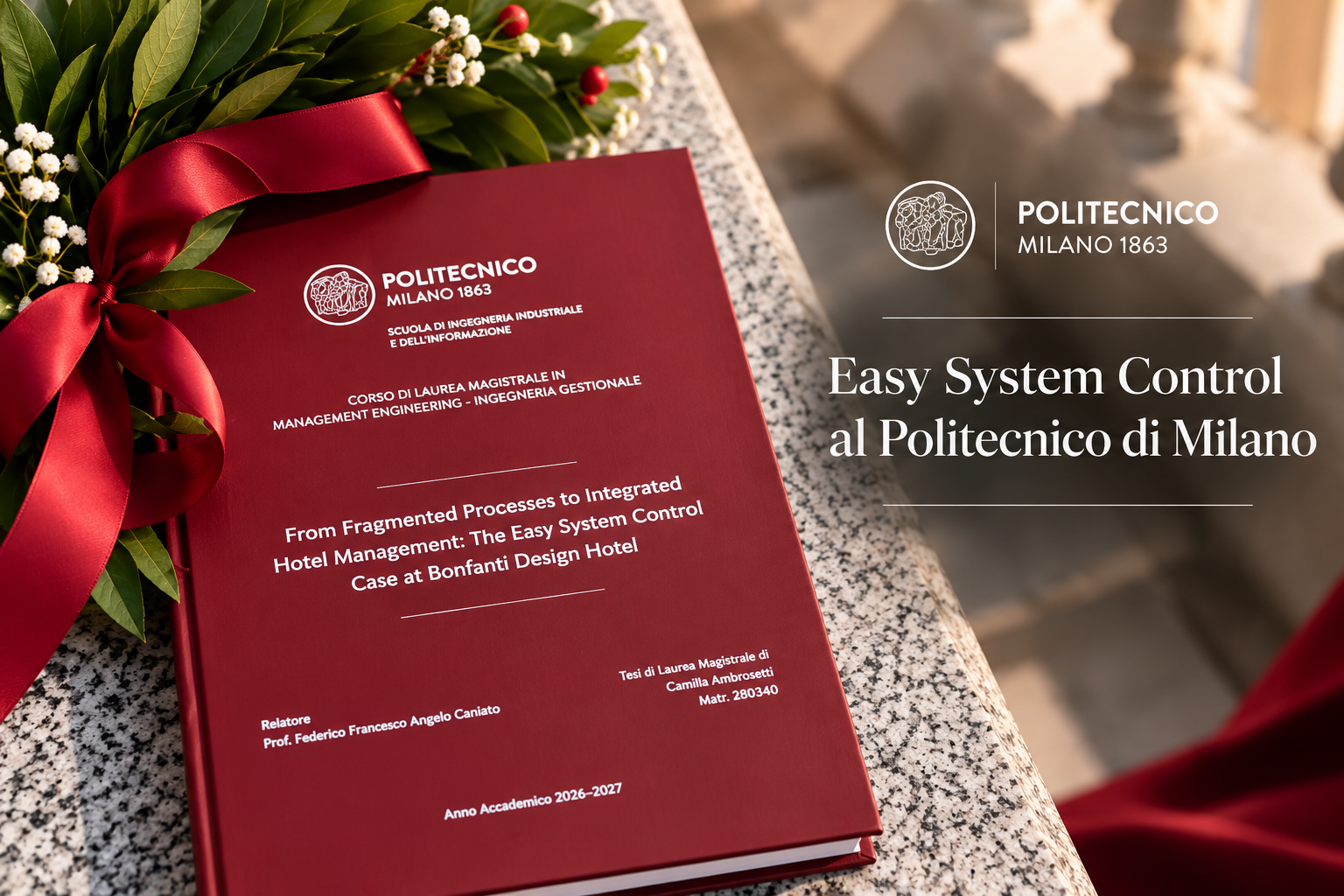
From hotel operations to academic research: Easy System Control becomes the subject of a Master’s thesis in Management Engineering at Politecnico di Milano, through an in-depth analysis of the Bonfanti Design Hotel case.
An important milestone for Easy System Control (ESC), the integrated digital platform developed to make hotel management more efficient, organized, and data-driven.
ESC has become the focus of a Master’s thesis in Management Engineering at Politecnico di Milano, written by Camilla Ambrosetti under the supervision of Prof. Federico Francesco Angelo Caniato.
The thesis, entitled “From Fragmented Processes to Integrated Hotel Management: The Easy System Control Case at Bonfanti Design Hotel”, explores the role of digitalization and process integration in hotel management, examining operational changes and measurable results observed following the implementation of ESC.
From Fragmented Processes to Integrated Hotel Management
The hospitality industry is facing increasingly complex challenges: rising operating costs, the need to optimize resources, and the growing importance of performance monitoring.
Despite the widespread adoption of specialized software solutions, many hotels still operate through disconnected systems, spreadsheets, and manual communication between departments.
The challenge, therefore, is not necessarily a lack of digital tools, but rather the difficulty of connecting information, people, and processes within a unified management system.
Easy System Control was developed precisely to address this need. Originally conceived at Bonfanti Design Hotel, a four-star superior hotel in South Tyrol, ESC was designed to overcome operational inefficiencies identified in daily hotel management.
ESC aims to eliminate information fragmentation through a modular, integrated platform, where data generated by different departments becomes accessible and actionable, improving coordination and supporting management decisions.
The Bonfanti Design Hotel Case: A Concrete Analysis of Results
The core of the thesis focuses on the implementation of Easy System Control at Bonfanti Design Hotel.
The research combined a quantitative analysis of operational data covering the period 2020–2025 with a qualitative study of business processes, comparing workflows before and after the introduction of the platform.
The objective was not simply to describe ESC’s features, but to understand which changes it contributed to, through which mechanisms, and with what measurable results.
The analysis focused on three main areas: breakfast operations, dinner service, and personnel management. It also considered the influence of external factors, including food inflation, rising labor costs, and the post-pandemic recovery in tourism demand.
Key Findings
The data revealed significant improvements in the hotel’s operational efficiency.
In particular, between 2022 and 2025, the following results were observed:
- Breakfast: a 10.5% reduction in average cost per guest, despite an approximately 14% increase in guest numbers.
- Dinner: an approximately 9.5% reduction in average cost per guest.
- Food waste: a decrease in waste incidence in both breakfast and dinner operations.
- Staff productivity: a 14.5% increase in the productivity indicator, which remained stable from 2023 through 2025.
Beyond these quantitative results, the process analysis highlighted organizational benefits, including greater task traceability, improved information sharing between departments, and fewer manual handovers.
The findings suggest that ESC’s value lies not simply in digitalizing individual activities, but above all in its ability to integrate information flows and support more accurate planning of operations and resources.
Although not all improvements can be attributed exclusively to the platform, the research identified operational mechanisms through which ESC contributed to the hotel’s efficiency improvements.
When Hotel Innovation Meets Academic Research
The study of Easy System Control within a Master’s thesis at Politecnico di Milano represents a significant milestone for the project.
The research provided an opportunity to examine ESC from an analytical perspective, applying Management Engineering methodologies to investigate its functionality, operational benefits, and potential areas for improvement.
One particularly important insight emerging from the study is that efficiency does not come from technology alone, but from the ability to use it to rethink and improve the way a hotel operates.
Data integration, process standardization, and greater access to management information can become essential tools for more structured and informed hotel operations.
For Easy System Control, being the subject of an academic case study represents an important opportunity to highlight the work carried out and the results observed in practice.
A journey that demonstrates the importance of bringing technological innovation closer to the real needs of hoteliers, transforming operational experience into practical tools for management and continuous improvement.
Through this thesis, Easy System Control also enters the world of academic research, bringing to Politecnico di Milano a concrete example of how the integration of technology, organization, and management control can contribute to the evolution of the hospitality industry.